Sunday, July 28, 2019

Harmonica player Billy Branch to perform at College of DuPage in Glen Ellyn as part of "Chicago Plays the Stones" show


By ERIC SCHELKOPF

Billy Branch not only learned how to be a better harmonica player while he was touring with Chicago blues legend Willie Dixon, he also learned more about how blues music has shaped our culture.

Branch will perform with Ronnie Baker Brooks, John Primer, Jimmy Burns and Omar Coleman at 7:30 p.m. Aug. 1 at McAninch Arts Center's Lakeside Pavilion as part of "Chicago Plays the Stones," a project that celebrates the deep relationship between world’s biggest rock band and the electric blues of Chicago. A full 50% of all profits from sales of the CD go to Generation Next, a music education and youth mentoring program under the aegis of the Chicago Blues Experience Foundation and supporting the next generation of Chicago blues artists.

The show is being presented by WDCB as part of the Lakeside Pavilion Free Outdoor Summer Series. Lakeside Pavilion is located on the College of DuPage campus, 425 Fawell Blvd., Glen Ellyn. 

Food and beverages will be available for purchase. Outside alcohol, as well as coolers, kegs, umbrellas, tents and skateboards, is not permitted onto the property. More information is available by going to atthemac.org.

I had the chance to talk to Branch about the upcoming show:

Q – As far as wanting to be part of this project, "Chicago Plays the Stones, what made you want to be part of it?

It was produced by Larry Skoller and I've been part of several of his other projects that he did, notably, "Chicago Blues: A Living History."

This project was a novel idea. As far as I know, I don't think anybody else has taken on such a project. It was kind of like full circle, since The Rolling Stones started out with the blues, emulating their blues musician heroes.

Q – But in turn do you think people will kind of get a history lesson and realize that The Rolling Stones – if they didn't know already – were heavily influenced by Chicago blues artists?

Yeah, you could definitely look at it from that perspective. 


Q – As far as the songs that you're featured on, like "Sympathy for the Devil,"for instance, how did you try to change it up?

Again, you're always challenged when you are embarking on re-recording iconic or classic tunes associated with a famous group like The Rolling Stones. I had nothing to do with the arrangement, but my challenge was giving it a suitable and hopefully dynamic interpretation of it.

While evoking the sentiment of the original, you still have to find a way to kind of make it your own. 

Q – You've been touring as part of this project since late 2018. Have the crowds all responded well?

Yes. We've heard comments that they like some songs better than the original.

Now that I was able to absorb all of the actual lyrics, I discovered more depth to their writing. For example, "Sympathy for the Devil" is essentially a history lesson.

In learning all of these lyrics, I have newfound respect for Mick Jagger and Keith Richards as songwriters. I was surprised at how deep that song is and the historical references they make in "Sympathy for the Devil." There's a lot of specific historical references.


Q – At the College of DuPage show, you're also going to be playing songs from your album on Alligator Records, "Roots And Branches – The Songs Of Little Walter." Was that an album that you always wanted to do? 

Last year, we produced a tribute show on the main stage at the Chicago Blues Fest marking the 50th anniversary of Little Walter's passing. Between my wife and Little Walter's daughter, this became a natural segue in terms of recording an album.

Q – As far as paying tribute to Little Walter on this album, what were you looking for this album to do?

We wanted to adequately capture the spirit and stylings of Little Walter and at the same time, bring a freshness and put our own stamp on it as a group, as the Sons of Blues, which was challenging in its own right. Because Little Walter was truly the greatest blues harmonica player and one of the greatest harmonica players in any genre.

And he's the most influential. Traveling around the world, even in China and in the Andes Mountains, I've encountered people trying to play like Little Walter. So we were challenged to present some of his time-worn classics and present them in a fresh way, if you well, without sacrificing or diminishing the integrity of his artistry.

Q – You just talked about Little Walter being one of the greatest harmonica players ever. Did you feel a little intimidated to even try to tackle something like this?

 I've been playing Little Walter's songs for many decades. But there was a challenge because you don't want to do anything that comes off as inferior or that you are just copying him.

So the challenge was to make this fresh and vibrant and original, but yet, capture the stylistic feeling of the old songs. So it was challenging.

Q – How have you tried to set yourself apart from other harmonica players?

Over the years, I've developed my own style, although I closely followed and practiced and learned the styles of many harmonica players, including Sonny Boy Williamson and Little Walter. And I learned first hand from Junior Wells and James Cotton, Carey Bell and Big Walter Horton, who were Little Walter's peers.

And so though I missed Little Walter (he died in 1968), I did get to learn from the greatest living artists at that time. My style is a reflection of my musical influences.


Q – You've been leading your group, Sons of Blues, for more than 40 years. You celebrated your 40th anniversary a couple of years ago. I was reading a story from a couple of years ago saying that you've been playing tribute to elder statesmen of the blues for so long that you've actually become one. Do you see yourself as an elder statesmen of the blues?

Well, whether I see myself as an elder statesmen or not, apparently, that's how others see me. The sad part about that is that of course, so many of those great, great, original artists have passed on.

The fortunate part was that I got play and record with so many of them. I was in Willie Dixon's band for about six years. And then I played with Koko Taylor, Lonnie Brooks, Son Seals, Magic Slim, David "Honeyboy" Edwards and Otis Rush.

During those learning years, I took it very seriously. I was very humbled by their musical prowess and I was very serious about trying to learn this music to the best of my ability.

So now that they have passed on, this is how I am being characterized in some circles.

Q – When you started touring with Willie Dixon's Chicago Blues All Stars, how old were you?

Oh, I was probably about 24 or 25 years old.

Q – You've done a lot for only being 67 years old. You're a young elder statesman.

Well, that's one way of looking at it.

Q – What were the biggest things that you learned when you started touring with Willie Dixon?

The main things I learned from Willie was about the immense scope of the blues and I acquired a deeper love and respect for the music. Willie was a guy who was a philosopher as well as a great poet and writer.

He realized and was constantly preaching about the importance and significance of the blues in an historical, social and political context. I'll give you an example. Even before officially joining the band, he shared with me a letter that he sent to the FCC and every member of Congress.

This letter stated that there was a conspiracy to keep the blues off the radio. He drew a correlation between marginalizing the blues and racial discrimination.


The blues, of course, is first and foremost African-American folk music. And the culture is embedded in it. It's like the soundtrack of this African-American existence in this culture.

By exposing more people to the blues, his reasoning was that then you expose them to their history. And then when you start investigating their history, you start really realizing the many contributions and accomplishments that they have made. And that decreases your ability to discriminate against them.

And then musically I learned so much, of course. I became a much better player. I thought I was good when I joined the band and I quickly discovered how much I did not know.

But Willie had a lot of faith in me. He just kind of nurtured me until I really got up to speed. 

Sunday, July 14, 2019

Jazz Up Glen Ellyn serves up many tasty musical treats

 The Geof Bradfield Quartet was one of several acts that performed at Jazz Up Glen Ellyn on July 13. 

Those who braved Saturday's heat were treated to several top notch band performing a vibrant blend of musical styles during the fourth annual Jazz Up Glen Ellyn festival in downtown Glen Ellyn.


High-Hat Second Line parades through downtown Glen Ellyn on Saturday.

 Chicago artist Lewis Achenbach interpreted the music and atmosphere of Jazz Up Glen Ellyn during his Jazz Occurrence.


                               High-Hat Second Line performs Saturday at Jazz Up Glen Ellyn.


 Geof Bradfield Quartet performs Saturday at Jazz Up Glen Ellyn.


Ernest Dawkins New Horizons Ensemble performs Saturday at Jazz Up Glen Ellyn.

Thursday, June 13, 2019

Coco Montoya to bring searing guitar playing, soulful vocals to Blues on the Fox festival


By ERIC SCHELKOPF

In making the switch from being a drummer to a guitarist, Coco Montoya turned to the best teacher he knew – legendary blues guitarist Albert Collins.

Collins would always tell Montoya, "don’t think about it, just feel it." Montoya continues to follow that advice to this day.

Montoya will perform as part of the 23rd annual Blues on the Fox festival taking place June 14 and 15 at RiverEdge Park in downtown Aurora.

Gates open at 6 p.m. June 14 at 360 N. Broadway (Route 25). At 7 p.m., blues guitarist and singer Ana Popovic will take the stage, followed by the legendary Taj Mahal at 9 p.m.

Gates open at 2 p.m. for the second day of Blues on the Fox on June 15. Up-and-coming Chicago blues guitarist Jamiah Rogers will perform at 3 p.m., followed by Chicago-born musician Ronnie Baker Brooks at 5 p.m., Montoya at 7 p.m., and Robert Randolph and the Family Band at 9 p.m.

General admission tickets cost $20 per day. Children 12 and younger are admitted free to Blues on the Fox, but must be accompanied by an adult age 18 or older.

For tickets and information, visit RiverEdgeAurora.com, call the box office at 630-896-6666, or stop by in person at RiverEdge's satellite box office, the Paramount Theatre, 23 E. Galena Blvd., Aurora, open from 10 a.m. to 6 p.m. Monday through Saturday.

I had the chance to talk to Montoya about the upcoming show.
  

Q – I was trying to remember the last time we talked. I know it's been a while. You used to be a regular at Chord on Blues in St. Charles, correct?

Yeah, I haven't heard that name in a while. That was a really cool place.

Q – It was a cool place. It's been closed for several years now. 

Q – You are playing at several blues festivals this year, including at the WC Handy Blues and Barbecue Festival the day before Blues on the Fox. I see that Ronnie Baker Brooks will be part of the Chicago Plays The Stones show at that festival, so you will be seeing him two days in a row since he will also be at Blues on the Fox.

As far as playing festivals, is that one of the things you find enjoyable, performing with people you might not play with as part of a club date?

Yeah, it's always nice seeing other players that you know and respect. Ronnie is definitely one of those. I've known him for many, many years and I was pretty close to his father as well.

It's going to be wonderful to see Ronnie and watch him perform. Hopefully we'll be able to get together ourselves and maybe do something [together] if time allows.

Q – So you guys might jump on stage together?

You never know. It's always better when you don't have to plan too much. It's just something that you take advantage of if the opportunity presents itself. 

Q – I know you have a new record coming out on Chicago-based Alligator Records, "Coming in Hot," on Aug. 23. During Blues on the Fox, will you be playing any songs from the new album? 

I think we're going to do one. We do have one that we want to feature and show everybody. 

Q – The album is going to be called "Coming in Hot." Does the album's title express the tone of the record? 

You know, I don't know if it really does. It's still kind of new to everybody.

The album comes from an emotional place as opposed to really thinking it out too much.

Q – Your latest record on Alligator Records, 2017's "Hard Truth," received a lot of acclaim. What were your goals for the album and do you think you accomplished them? 

Once again, I never approach a project with any kinds of goals in mind. It's just honest music that can stand on its own merits.

That's the main agenda for me – to go out and play the music that I like and let it stand for itself. I just want to feel it. I just want to feel it and enjoy the music that I play.

If the audience is going to like it, great. I would love that. You just kind of have to be true to yourself. The fans will embrace it or not embrace it. 


Q – Because isn't that one of the things that Albert Collins kind of taught you? He would always say, "Don't think about it. Just feel it."

That is absolutely true. There were no borders, no gates, no fences for him. He played what he felt like playing.


It's definitely something I live by. I'm going to play the music I enjoy playing and hopefully the people will like it.

Q – "Hard Truth" marked your return to Alligator Records. Why did you want to return to Alligator Records? 

Everything just kind of fell into place. Alligator is a really great label. It has a great promotional team.

The amazing part of that label is the people that work there. They work hard to promote an album. They really do.

Q – And of course, you also played in John Mayall’s band for 10 years. When he picked you to play with him as part of the reformed Bluesbreakers, what were your thoughts and did you feel any pressure at the time?

Well, yeah. It was quite exhilarating but there was a lot of pressure because I held Eric Clapton and Mick Taylor and Peter Green in high esteem.


I wouldn't be doing what I'm doing now if it wasn't for John.

Q – I saw a photo posted on your Facebook page showing you standing with Charlie Musselwhite, B.B. King, John Mayall, Deacon Jones and Water Trout.

To look at this picture today and see yourself standing with these blues greats, does it still boggle your mind that you were able to stand with these people?


Oh, yeah. You are just covered in gratitude. Me and Charlie are good friends. And Walter and I are very close.

B.B. King was always wonderful to me. I first met him back in the '70s.

He was always very kind. We used to have some great conversations. I miss him a lot.

Q – It is sad that we are losing more and more blues legends. What do you think of the blues music scene today? Do you think it's thriving?

I'm not so sure that it's thriving like it once was. It's evolving.

I think that's pretty much a better word for it. It's evolving. We're getting many different kinds of players.

There's so many bands and not enough venues to go around. But yeah, the blues is still alive.

Q – You fell in love with the blues after seeing Albert King opening up a Creedence Clearwater Revival/Iron Butterfly concert in 1969 at the Shrine Auditorium in Los Angeles. What was it that made you want to become a blues musician?

I said, ah, this is something that I can feel. It was a totally emotional event.

Everything that I ever liked was all about emotion. The blues brought me everything I wanted.

I gravitated to that after seeing Albert King play live. I realized that was something I wanted to know more about.

Q – What keeps you going?

Paying the bills and making sure my wife has a room over her head. This is the only thing I know how to do. This is the best thing I know how to do, anyway.

And I love playing. As I get older, it gets harder. My hands get stiffer.

I'm still enjoying it. I have some great musicians with me on this tour. I'm very grateful to have them.

Q – Just looking at your schedule, you've been busy all year. As far as playing live, is that the best part of what you do?

It's the ultimate best part of what I do. I'm out there playing live in front of an audience. There's no other reward that even comes close, in my opinion.


I'm not into awards. That's not my thing. My thing is being out in front of an audience that's enjoying the show and going out and shaking a few hands.

I'd rather being doing that than anything else.

Q – It seems like you have a lot of diehard fans. I've been scrolling through your Facebook page and there's picture after picture of fans with you. Is it a great feeling to be able to meet your fans and find out what they like about your music?

It always feels good to be that close to your fan base, to be able to give them a few minutes here and there. At every show,  I like to shake a few hands, sign a few posters and take some pictures.

I really have no problem in doing that, because if it wasn't for them, I'd have no work.

Tuesday, June 4, 2019

The Venue brings intimate music experience to downtown Aurora

Missy and Heine Andersen perform June 2 at The Venue in Aurora.

By ERIC SCHELKOPF

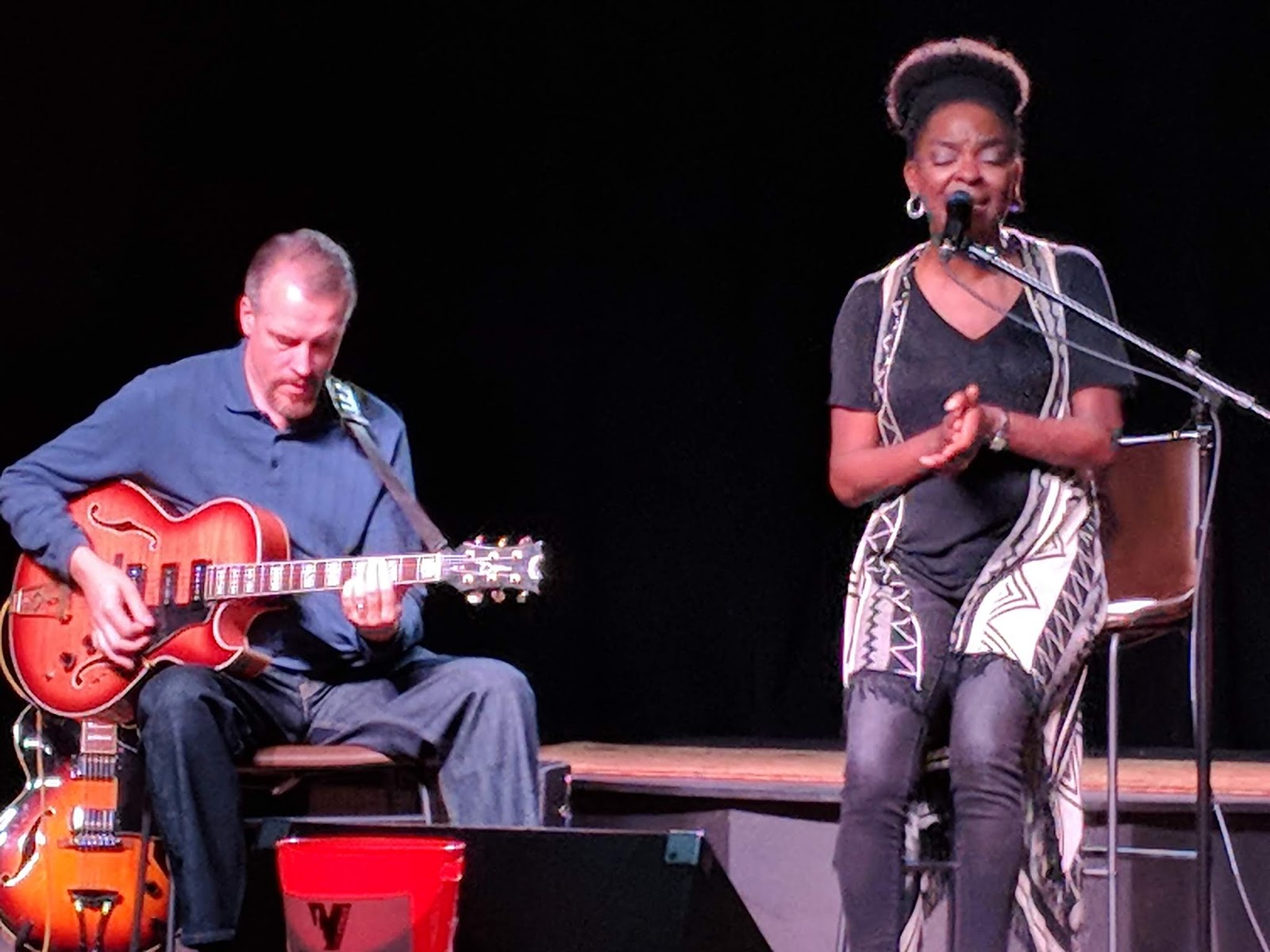
Missy Andersen and her guitarist/bandleader/husband Heine Andersen, brought their Soul Americana style on June 2 to The Venue at 21 S. Broadway Ave. (Route 25) between Galena Boulevard and Downer Place in downtown Aurora. The Venue is an intimate music space run by the nonprofit Fox Valley Music Foundation.

For more information, go to The Venue's website at themusicvenue.org.


Missy Andersen brought her soulful vocals and playful spirit to The Venue stage.


The Venue opened its doors on June 1 and will present local, regional and national acts.